How to Catalog Family Photos Without Losing Context
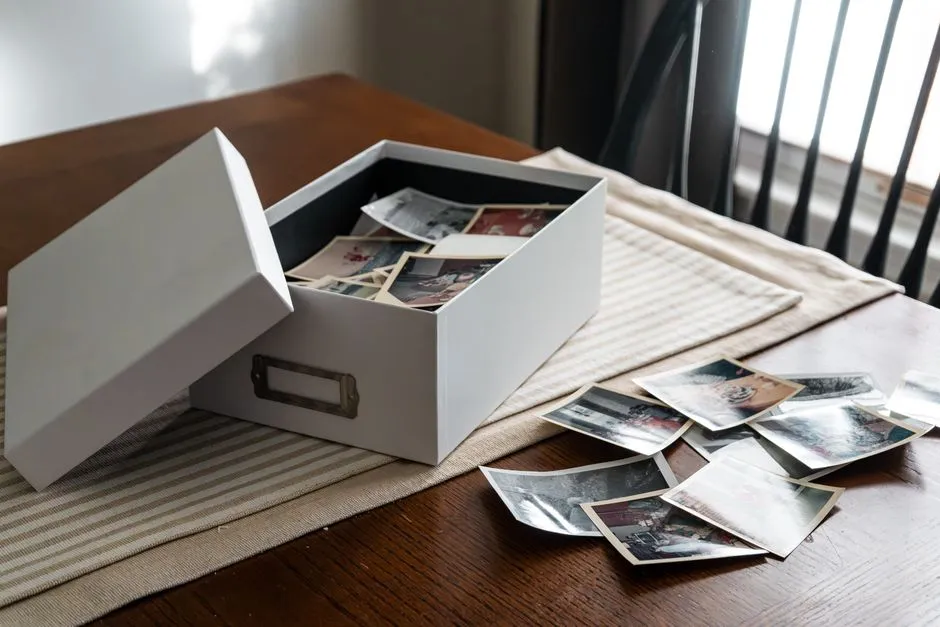
A catalog preserves context, not just image files
Begin by assigning each photograph, album, or meaningful group a stable identifier and recording where it physically lives. Then capture the names, place, event, date or date range, visible inscriptions, source of the information, and how certain that information is.
Do not begin by rearranging the entire collection into attractive piles. Existing album order, envelopes, captions, and neighboring photographs may be evidence, even when the current arrangement looks like a drawer lost an argument.
Photograph the collection before changing it
Take reference images of boxes, envelopes, album covers, full pages, and photo backs in their original order. Record which items were together. These working images do not replace careful scans; they preserve arrangement while the inventory is being built.
Work on a clean, dry, uncluttered surface away from food, drink, direct sunlight, pets, and adhesives. Handle photographs by their edges with clean, dry hands unless a qualified conservator recommends different handling for the process. Gloves can reduce dexterity and may not suit every material.
Do not clean, flatten, peel apart, or remove stuck photographs without appropriate conservation guidance.
Use a small set of catalog fields
A spreadsheet or database can begin with:
- Stable identifier
- Current box, album, page, or enclosure location
- Format and approximate dimensions
- Brief visual description
- People shown
- Place
- Event or activity
- Date or date range
- Words printed or written on the object
- Person or source supplying the identification
- Confidence: confirmed, probable, possible, or unknown
- Condition and handling notes
- Privacy, cultural, or rights restrictions
- Digital filename and backup status
Keep controlled terms simple. If one row says New York, another NYC, and a third Manhattan? maybe, searching becomes an unplanned tour.
The photo archives collection favors evidence fields because a name without its source can become impossible to verify after the identifying relative is gone.
Separate observation from identification
Write “three adults outside a brick storefront; sign reads M. Rossi Grocery” as an observation. Write “possibly Maria Rossi at left, identified by Daniel Chen on 2026-08-26” as an interpretation.
Do not use facial resemblance alone as confirmation. Clothing, automobiles, print process, addresses, studio marks, handwriting, and known events can narrow a date, but each clue has limits. Record the reasoning and keep a range rather than inventing a birthday-level precision.
Allow multiple candidate names. A transparent “possibly A or B” gives future researchers somewhere to work; a confident wrong caption sends everybody briskly in the opposite direction.
Label the enclosure, not the original
Ink, adhesive labels, pressure, and household tape can damage photographs. General internet advice cannot identify the process or recommend a universally safe pencil, sleeve, or placement.
Place the stable ID on an appropriate enclosure where possible, and keep descriptive data in the catalog. Consult a photograph conservator for valuable, fragile, cased, mounted, glass, nitrate, acetate, or otherwise unusual materials. Suspected unstable film may need specialist handling and safe storage.
Scan with a documented workflow
Clean scanner glass according to its manufacturer, without bringing liquid near photographs. Capture enough resolution and color information for the intended preservation and access use, following any receiving archive's requirements. Do not apply irreversible sharpening, color correction, or automatic face restoration to the only master.
Name files with the stable ID, preserve an unedited master, and create smaller access copies separately. Record scanner, settings, date, operator, cropping, and any edits. Scan fronts and backs when backs contain information.
Keep more than one backup in more than one location or system, subject to privacy and security needs. Test that files can actually be restored. “It synced once” is not a preservation plan.
Invite identification without giving away the answer
Show selected images to relatives or community members with consent. Ask open questions: What do you notice? Where might this be? Who could these people be? What makes you think so?
Record the identifier's name, interview date, exact claim, and confidence. If a conversation grows into broader memories, use the consent and recording plan in our guide to an oral-history interview.
Before publishing photographs, consider living people's privacy, cultural protocols, copyright, donor agreements, and sensitive locations. Ownership of a physical print does not automatically answer every reuse right.
The best catalog remains revisable. It preserves the item, the clues, and the honest boundaries of current knowledge so the next person inherits questions with evidence—not certainty with no receipts.